

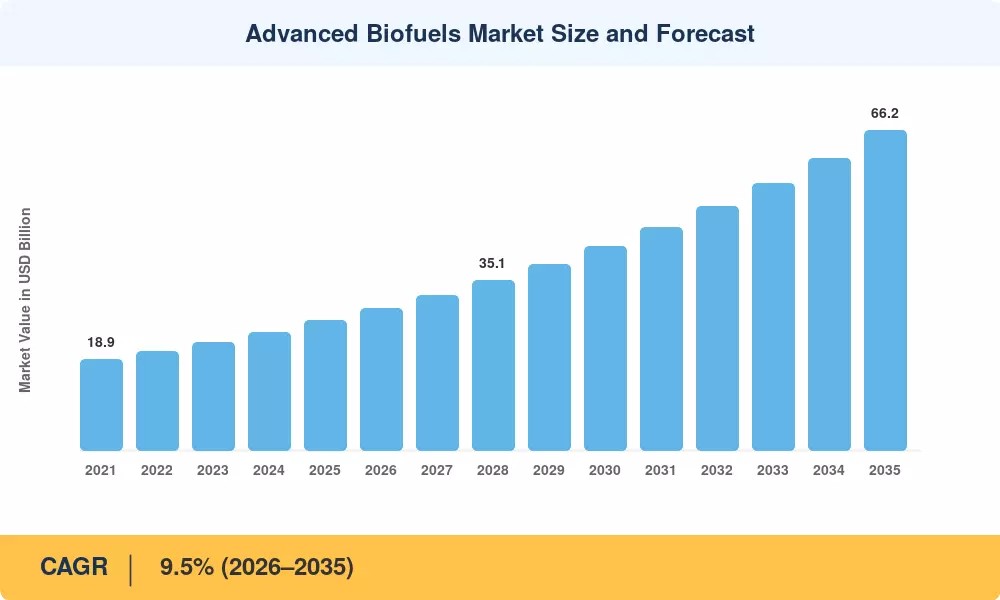
Advanced Biofuels Market to Reach USD 66.2 Billion by 2035 at 9.5% CAGR, Driven by Aviation Mandates and Carbon Pricing.
Advanced Biofuels Market Share
Renewable diesel and HVO hold approximately 34% of the Advanced Biofuels Market, owing to drop-in compatibility with existing diesel infrastructure.
Cellulosic ethanol accounts for an estimated USD 5.8 billion in 2025 revenue, with production scaling across the U.S. Midwest and Brazil.”
NEW YORK, NY, UNITED STATES, July 29, 2026 /EINPresswire.com/ -- The Advanced Biofuel Market reached an estimated USD 26.8 billion in 2025 and is projected to grow from USD 29.3 billion in 2026 to USD 66.2 billion by 2035, registering a CAGR of 9.5% during the forecast period (2026–2035).— Prashant Hake
Market Overview
Advanced Biofuels Market represent a diverse group of renewable fuels produced from non-food feedstocks, including agricultural and forestry residues, waste oils and fats, municipal solid waste, and novel biomass sources such as algae. Unlike first-generation biofuels derived from food crops like corn and sugarcane, advanced pathways utilize cellulosic, waste, and gaseous carbon streams to produce drop-in fuels that are chemically identical to petroleum-based gasoline, diesel, and jet fuel. These fuels deliver lifecycle carbon reductions of 60–85% compared to fossil baselines while avoiding food-versus-fuel competition and land-use change concerns. Key product categories include renewable diesel (HVO), sustainable aviation fuel (SAF), cellulosic ethanol, bio-methanol, and other emerging pathways such as alcohol-to-jet and gas fermentation technologies.
The market's robust expansion is anchored in tightening renewable fuel mandates across OECD nations and a surge of capital flowing into sustainable aviation fuel production capacity. The U.S. Inflation Reduction Act allocated over USD 500 million in clean fuel production tax credits through 2027, while the EU's ReFuelEU Aviation regulation mandates a 6% SAF blend by 2030, creating a guaranteed offtake runway worth an estimated USD 3.5 billion annually by 2030. Global investment in cellulosic and waste-to-fuel facilities topped USD 12 billion in 2024, with over 120 commercial-scale plants either operational or under construction. The International Energy Agency projects that advanced biofuel production must triple by 2030 to align with net-zero pathways, underscoring the sector's critical role in decarbonizing hard-to-abate transport sectors.
A decisive shift is underway from first-generation crop-based biofuels toward second- and third-generation pathways that convert non-food feedstocks into drop-in fuels. This transformation addresses historical criticisms while delivering superior carbon reduction performance. The integration of artificial intelligence and digital twin technologies is optimizing production yields by 8–15% through real-time monitoring of enzymatic hydrolysis, fermentation parameters, and catalyst performance, reducing per-gallon production costs toward fossil fuel parity by the early 2030s. North America commands approximately 38% of the market, driven by robust federal and state incentives, while Asia-Pacific is the fastest-growing region at a projected CAGR of 12.1%, fueled by ambitious blending mandates in India, China, and Southeast Asia. Europe holds about 29% share, supported by the RED III directive and heavy SAF investment.
Get Free Sample Report for Detailed Market Insights:
https://www.marketresearchfuture.com/sample_request/10039
Market Segmentation
The Advanced Biofuels Market is comprehensively segmented across fuel type, feedstock, application, and region to capture diverse production pathways and end-use requirements. By fuel type, renewable diesel and HVO hold approximately 34% of the market, owing to drop-in compatibility with existing diesel infrastructure and no engine modification requirements. Neste, TotalEnergies, and Marathon Petroleum collectively operate over 5 million tonnes of annual HVO capacity. Biojet fuel (SAF) is the fastest-growing fuel segment at a projected CAGR of 14.2%, driven by aviation decarbonization mandates and airline offtake agreements totaling over 40 billion liters in forward purchase commitments. Nine ASTM-certified SAF production pathways exist, though HEFA dominates at approximately 85% of current output. Cellulosic ethanol accounts for an estimated USD 5.8 billion in 2025 revenue, with production scaling across the U.S. Midwest and Brazil, though capacity utilization remains below 70% as feedstock logistics mature. Biodiesel (FAME) holds 22% share as a mature technology serving emerging-market blending laws, while bio-methanol and others are growing at 8.9% CAGR, driven by maritime decarbonization and chemical feedstock demand.
By feedstock, waste oils and fats constitute the dominant category at roughly 31% share, favored for lower processing costs and favorable carbon intensity scores, though supply constraints in Europe have driven prices up 40% since 2021. Agricultural and forestry residues are growing at 10.8% CAGR, driven by improved pretreatment technologies and policy incentives for non-food feedstocks. Energy crops including miscanthus and switchgrass account for USD 2.4 billion, while algae and novel feedstocks represent the fastest-growing category at 15.3% CAGR with long-term potential. By application, road transport absorbs 58% of volumes through established blending infrastructure, while aviation is the fastest-growing application at 16.8% CAGR, with airlines collectively committing to over USD 15 billion in forward SAF purchase agreements. Marine applications generated USD 1.2 billion in 2025, driven by IMO GHG Strategy requirements and dual-fuel vessel orders.
You can buy this market report at:
https://www.marketresearchfuture.com/checkout?currency=one_user-USD&report_id=10039
Regional Analysis
North America generates USD 10.2 billion in advanced biofuel revenue, representing 38% of the global market, led by U.S. federal credit programs. The United States accounts for 82% of regional value through a combination of federal RFS volume mandates, IRA production tax credits, and state-level LCFS programs. Over 15 petroleum refinery conversions to renewable diesel were announced between 2021 and 2024, concentrated along the Gulf Coast and West Coast corridors. The SAF Grand Challenge targets 3 billion gallons of domestic SAF production by 2030, backed by a USD 1.25-per-gallon blender's tax credit. Canada's Clean Fuel Regulations, effective since 2023, established lifecycle-based carbon intensity standards that favor advanced pathways and attracted investments into HVO production.
Asia-Pacific is the fastest-growing region at 12.1% CAGR through 2035, with India's 20% ethanol-blending target serving as a key catalyst. India represents the market's most ambitious growth story, with government-backed 2G ethanol plants at Panipat, Bathinda, and Numaligarh receiving INR 10,000 crore in public investment, and Indian Oil Corporation starting trial operations at the Panipat plant in November 2023, India's first commercial-scale cellulosic facility processing rice straw. China focuses on waste-oil collection for biodiesel, with over 3 million tonnes of annual UCO exports redirected toward domestic advanced fuel production. Indonesia, the world's largest palm oil producer, has piloted B35 blending for biodiesel, while Brazil's RenovaBio program sets annual decarbonization targets driving demand for second-generation ethanol.
Europe represents approximately 29% of global value, underpinned by RED III and ETS carbon pricing, which sets binding sub-targets for advanced biofuels at 1% of transport energy by 2025 and 5.5% by 2030. Germany leads with 24% of regional share under the BImSchG advanced biofuel quota. The Netherlands has emerged as a SAF production hub, hosting both Neste's Rotterdam expansion and SkyNRG's planned DSL-01 facility. Finland's Neste Porvoo refinery operates the world's largest single-site renewable diesel unit at 1.4 million tonnes annually. TotalEnergies began SAF production at Grandpuits biorefinery near Paris in August 2023, targeting 210,000 tonnes per year of renewable jet fuel and renewable diesel. South America, led by Brazil's RenovaBio program assigning tradable decarbonization credits, and the Middle East & Africa, with the UAE's Masdar initiative and Etihad Airways' SAF procurement commitments, represent smaller but growing markets.
Competitive Landscape
The Advanced Biofuels Market exhibits moderate concentration, with the top five producers holding an estimated 28–33% combined revenue share and a Herfindahl-Hirschman Index in the low-to-moderate range reflecting a mix of integrated oil majors, pure-play biofuel specialists, and technology licensors.
Neste Oyj holds 8–11% market share as the largest global HVO producer with vertically integrated feedstock sourcing, offering renewable diesel and SAF through its MY Renewable Jet Fuel portfolio. TotalEnergies SE captures 4–6% through refinery conversions at La Mède and Grandpuits, positioning as a European SAF leader. Marathon Petroleum holds 3–5% with renewable diesel production at its Dickinson, North Dakota refinery conversion, optimizing U.S. LCFS credits. Gevo Inc. holds 2–3% with SAF via alcohol-to-jet technology, having secured USD 1.46 billion in conditional loan guarantee from the U.S. DOE in January 2025 for the Net-Zero 1 SAF plant in South Dakota. LanzaTech Global holds 2–4% through proprietary gas fermentation ethanol and SAF, licensing its carbon-recycling biology platform. POET LLC holds 3–5% as the largest U.S. ethanol producer with cellulosic demonstration at Project Liberty. Other significant players include Enerkem, Raízen, Verbio, and World Energy.
Key players are investing heavily in SAF capacity expansion, feedstock diversification, and digital process optimization. The competitive landscape is shifting from single-output fuel plants toward integrated biorefineries producing fuels alongside biochemicals, bioplastics, and specialty molecules, improving internal rates of return by 20–35%.
Latest Industry News & Developments
In January 2025, Gevo secured USD 1.46 billion in a conditional loan guarantee from the U.S. DOE Loan Programs Office for the Net-Zero 1 SAF plant in Lake Preston, South Dakota, marking one of the largest federal commitments to advanced biofuel production. In November 2023, Indian Oil Corporation started trial operations at the Panipat 2G ethanol plant, India's first commercial-scale cellulosic facility processing rice straw at 100 KLPD capacity. In August 2023, TotalEnergies began SAF production at the Grandpuits biorefinery near Paris, targeting 210,000 tonnes per year of renewable jet fuel and renewable diesel.
Market Challenges & Opportunities
High capital intensity of conversion facilities represents the most significant challenge, as a commercial-scale cellulosic ethanol plant requires USD 250–400 million in upfront capital with construction timelines stretching 3–5 years, limiting market entry to well-capitalized incumbents. Feedstock supply variability persists, as agricultural residue availability fluctuates with crop yields and competing uses, while Europe's used cooking oil supply is already constrained with sustainability traceability concerns. Policy uncertainty around U.S. renewable fuel tax credits and RFS volume obligations creates investment hesitancy, with potential rollbacks causing temporary delays in final investment decisions.
However, significant opportunities are emerging across multiple dimensions. Sustainable aviation fuel scale-up represents the most transformative opportunity, as SAF currently represents less than 1% of global jet fuel consumption, leaving a massive addressable gap as mandates ramp toward 2030 targets. Waste-to-fuel circular economy models that divert municipal solid waste and industrial organic waste into fuel production generate tipping fee revenue alongside fuel sales, improving project economics by 15–25%. Carbon credit and sustainability data monetization through granular lifecycle analysis and blockchain-based traceability platforms enable producers to monetize emissions reduction data through voluntary carbon markets, which exceeded USD 800 million for verified fuel credits in 2024. Emerging-market biofuel infrastructure development across Southeast Asia, sub-Saharan Africa, and South America, supported by over USD 2 billion in international development finance commitments, could unlock 500 million tonnes of annual feedstock currently going unutilized. Marine biofuel adoption under the IMO's 2023 GHG Strategy targeting a 20% reduction in shipping emissions by 2030 is creating demand for bio-methanol and straight vegetable oil blends for short-sea shipping routes.
To explore more market insights, visit us at:
https://www.marketresearchfuture.com/reports/advanced-biofuels-market-10039
Final Market Summary
The Advanced Biofuels Market is positioned for exceptional growth, with projections indicating a near-2.5-fold increase from USD 26.8 billion in 2025 to USD 66.2 billion by 2035, at a CAGR of 9.5%. This expansion is underpinned by aviation SAF mandates, renewable fuel standard credit economics, carbon pricing mechanisms, and emerging-market blending mandates that create sustained policy-driven demand. While challenges including high capital intensity, feedstock supply variability, and policy uncertainty persist, emerging opportunities in SAF scale-up, waste-to-fuel circular economy models, carbon credit monetization, and marine biofuel adoption offer substantial potential for industry participants. The future market landscape will be defined by companies that successfully secure long-term feedstock agreements, leverage digital optimization to reduce production costs, develop integrated biorefinery platforms, and capture value from sustainability data and carbon credits, with Asia-Pacific set to dominate growth through ambitious national blending mandates while North America and Europe sustain demand through regulatory frameworks and corporate offtake commitments.
More Related Reports from MRFR Library:
Microgrid Monitoring Market: https://www.marketresearchfuture.com/reports/microgrid-monitoring-market-7049
Solar Backsheet Market: https://www.marketresearchfuture.com/reports/solar-backsheet-market-7066
Timing Relay Market: https://www.marketresearchfuture.com/reports/timing-relay-market-7067
Vacuum Contactor Market: https://www.marketresearchfuture.com/reports/vacuum-contactor-market-7071
Direct Methanol Fuel Cell Market: https://www.marketresearchfuture.com/reports/direct-methanol-fuel-cell-market-7116
Solar Water Heater Market: https://www.marketresearchfuture.com/reports/solar-water-heater-market-7132
Subsea Control Systems Market: https://www.marketresearchfuture.com/reports/subsea-control-systems-market-7141
Intelligent Pigging Market: https://www.marketresearchfuture.com/reports/intelligent-pigging-market-7151
Electrostatic Precipitator Market: https://www.marketresearchfuture.com/reports/electrostatic-precipitator-market-7161
Coal Bed Methane Market: https://www.marketresearchfuture.com/reports/coal-bed-methane-market-7174
Larry Wilson
WantStats Research And Media Pvt. Ltd.
+ +1 855-661-4441
email us here
Visit us on social media:
LinkedIn
Facebook
YouTube
X
Legal Disclaimer:
EIN Presswire provides this news content "as is" without warranty of any kind. We do not accept any responsibility or liability for the accuracy, content, images, videos, licenses, completeness, legality, or reliability of the information contained in this article. If you have any complaints or copyright issues related to this article, kindly contact the author above.
